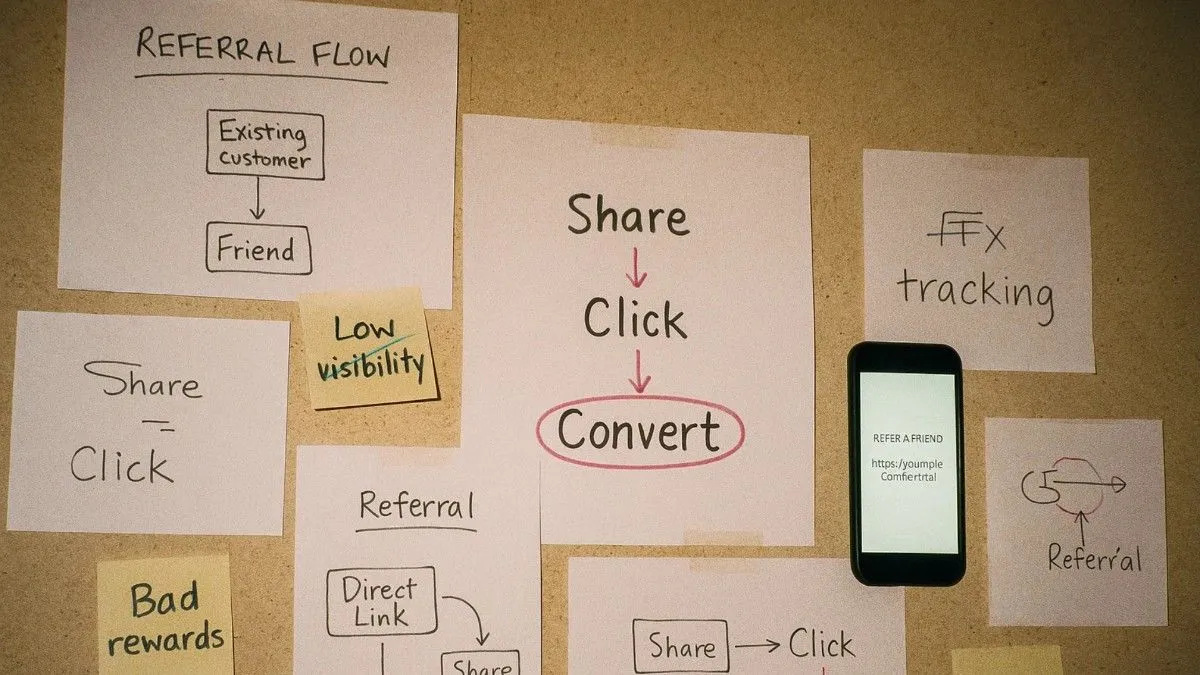
Quick answer: Most referral program mistakes come from low visibility, weak rewards, or poor tracking. Fixing these issues can lift revenue fast.
Table of Contents
- Why Referral Program Mistakes Matter
- Low Referral Visibility
- Weak or Irrelevant Rewards
- High Friction in the Sharing Flow
- Confusing Landing Pages
- Lack of Trust or Social Proof
- Poor Tracking and Attribution
- No Ongoing Promotion
- Launch / Optimise Checklist
- FAQ
- Takeaways
Why Referral Program Mistakes Matter
A referral program can lift customer acquisition without raising paid ads, but only when the underlying system works. Miss one step and performance drops across the share → click → conversion path. Brands that fix core referral performance issues often see share rates rise by more than 30 percent, unlocking higher revenue and more first-time buyers.
1. Low Referral Visibility
Most referral programs fail because customers never notice them. If the referral offer is buried in a footer or hidden in an account page, it will not drive volume.
How this affects performance
- Fewer people share their link or code.
- Even strong reward offers get ignored.
- You lose momentum right after purchase when enthusiasm is highest.
How to fix it
- Add a post-purchase popup right on the thank-you page; this is one of the strongest touch-points for prompting shares.
- Place a persistent widget on your account page or customer portal. According to our guide on how to promote your referral program, simple on-site placements can produce a large increase in share rate.
- Use always-on assets like packaging inserts and QR codes.
If you're using ReferralCandy’s referral tool, features like the post-purchase popup and embedded share forms make visibility a repeatable part of the purchase flow.
2. Weak or Irrelevant Rewards
If the incentive doesn’t feel meaningful or aligned with your product, customers have no reason to spend time sharing it.
What counts as “weak”
- Rewards below the value customers expect in your category.
Points instead of real monetary value. - Benefits that feel disconnected from the shopper’s actual needs.
Referral conversion rates improve sharply when brands use cash-equivalent or percent-off rewards, especially in categories like food and beauty where the 2025 referral benchmarks show high sensitivity to reward relevance.
How to fix it
- Test a small set of reward types.
- Keep the structure simple: “Give $10, Get $10” or “Give 15%, Get 15%.”
- Clearly state whether rewards stack or apply automatically.
ReferralCandy lets you run different reward formats (cash, credit, percent-off) so you can test which leads to the highest share and conversion lift.
3. High Friction in the Sharing Flow
Even customers with genuine intention to refer will abandon the process the moment it becomes slow or complicated.
Common friction points
- Needing to create an account to get a link.
- Manual copy-pasting across several screens.
- Long URLs that look suspicious when shared.
- No pre-written message for WhatsApp, SMS, or email.
How to fix it
- Auto-generate referral links immediately after checkout.
- Pre-load messages with product photos and a short promise.
- Use short links or branded domains to improve CTR.
ReferralCandy’s one-click sharing and auto-generated messages are built specifically to remove friction while lifting share volume.
4. Confusing Landing Pages
When referred visitors land on a page that doesn’t match the promise in the referral message, they drop off.
Why this happens
- The landing page has no visible discount.
- Copy doesn’t mention the friend who sent them.
- The reward explanation is unclear or hidden.
How to fix it
- Make the friend’s discount visually obvious above the fold.
- Use clear, short copy: “Your friend sent you a reward.”
- Auto-apply referral discounts to shorten the path (a proven conversion lift across many verticals).
5. Lack of Trust or Social Proof
Referred users may hesitate if they don’t feel confident in the product or the brand. Referral traffic is high-intent, but still needs reassurance.
What weakens trust
- No reviews or ratings near the offer.
- No visible proof that other customers have referred friends.
- Low-quality images or missing product details.
How to fix it
- Display reviews and star ratings near the referral section.
- Add small trust signals like “10,000 shoppers referred friends last month.”
- Keep product info above the fold.
This directly reflects data from the 2025 benchmarks report showing that adding a small amount of social proof increases click-through rates by ten to fifteen percent.
6. Poor Tracking and Attribution
Referral programs break down when tracking is inaccurate or slow. If your system cannot reliably attribute new customers to the correct advocate, no one trusts the rewards.
Common tracking issues
- Broken links or outdated codes.
Conflicting attribution windows. - No fraud checks, leading to self-referrals that reduce trust and cost margin.
How to fix it
- Audit links quarterly and test redemption on mobile.
- Use a consistent attribution window (typically 30 days).
- Enable fraud prevention with AI and ML for IP overlap or flagged devices
ReferralCandy’s built-in fraud protection and tracking tools help maintain clean attribution without needing manual checks.
7. No Ongoing Promotion
Launching a referral program once is not enough. Referral performance drops unless the brand continues to promote it through regular customer touch-points.
How this shows up
- Long gaps between referral mentions.
No reminders for customers with unused rewards. - No seasonal pushes after peak periods.
How to fix it
- Use reminder emails seven days after delivery; these remain one of the strongest triggers for renewed referral activity.
- Pin your referral link in social bios.
- Add a referral block to order-confirmation and shipping-update emails. This aligns with the 2025 referral promotion playbook, which shows how multi-channel reminders significantly increase share rates.
Launch / Optimise Checklist
- Add a post-purchase share popup on the thank-you page.
- Test your referral link and auto-apply discount.
- Add clear friend-reward copy to your landing page.
- Refresh rewards to match category expectations.
- Add review stars near your referral CTA.
- Schedule reminder emails seven days post-delivery.
- Audit your tracking setup for codes and attribution.
- If using ReferralCandy’s affiliate tool, enable auto-generated links and fraud checks to simplify performance monitoring.
FAQ
What’s the most important referral KPI to track?
Conversion rate is important, but it’s incomplete on its own. The real insight comes from viewing the entire funnel: share rate, CTR, conversion rate, and repeat purchase rate. When you only track conversions, you can’t tell whether problems come from visibility, message quality, or friction during checkout. A full-funnel view helps you pinpoint which lever needs attention, especially as referral programs mature.
How often should I review referral analytics?
A weekly glance is useful, but a monthly deep-dive is essential. You’ll want to look at channel performance, reward cost, fraud signals, and post-referral buyer behavior. Referral data compounds slowly, so monthly trends reveal what’s truly moving the needle. Brands with high referral volume can benefit from a weekly review to catch issues earlier.
How do I know if my referred customers are high quality?
Look at repeat purchase rate, AOV, refund behavior, and whether they refer others. Strong referral programs often create a positive loop where referred customers become referrers themselves. If your referred customers churn quickly or purchase only with heavy discounts, revisit your reward structure, landing pages, or product onboarding.
Do I need a separate tool for referral analytics?
Not necessarily. If you use an app like ReferralCandy, you already get funnel analytics, fraud tools, and post-purchase reporting. The benefit is having attribution, link tracking, and conversion data in a single dashboard rather than fragmented across several tools. This also reduces tracking errors and avoids data mismatches between platforms.
Takeaways
- Most referral program mistakes come from low visibility, unclear rewards, or broken tracking.
- Ongoing promotion and A/B testing are essential to keep referral activity rising.