
Quick answer: A strong customer advocacy program turns happy users into powerful sales drivers, amplifying trust and reducing acquisition costs by up to 30%.
Table of Contents
- Why Customer Advocacy Matters
- What a Customer Advocacy Program Looks Like
- How Advocacy Differs from Referrals
- Building Advocacy: From First Purchase to True Believer
- Scaling Advocacy With Technology
- Launch / Optimise Checklist
- FAQ
- Takeaways
Why Customer Advocacy Matters
The most credible marketing doesn’t come from ads—it comes from customers. A strong customer advocacy program transforms buyers into active promoters who drive new customers through referrals, reviews, and word of mouth.
ReferralCandy data shows that top-quartile programs drive 10–30% of total revenue through customer advocacy and referrals. That’s growth powered by trust, not ad spend.
What a Customer Advocacy Program Looks Like
A customer advocacy program formalizes what loyal customers already do: recommend products they love. The goal is to make it easy, rewarding, and measurable.
Core components:
- Referral layer: Give advocates a simple way to share links or codes.
- Recognition layer: Publicly celebrate top referrers in newsletters or communities.
- Reward layer: Offer meaningful rewards (cash, credit, or perks).
- Community layer: Create spaces for fans to connect and exchange stories.
Brands using tools like ReferralCandy can run referral and affiliate campaigns together—allowing loyal customers and creators to promote from one dashboard.
How Advocacy Differs from Referrals
Referrals are transactional—“Get $10 for every friend.” Advocacy goes deeper. It’s about emotional alignment and genuine enthusiasm.
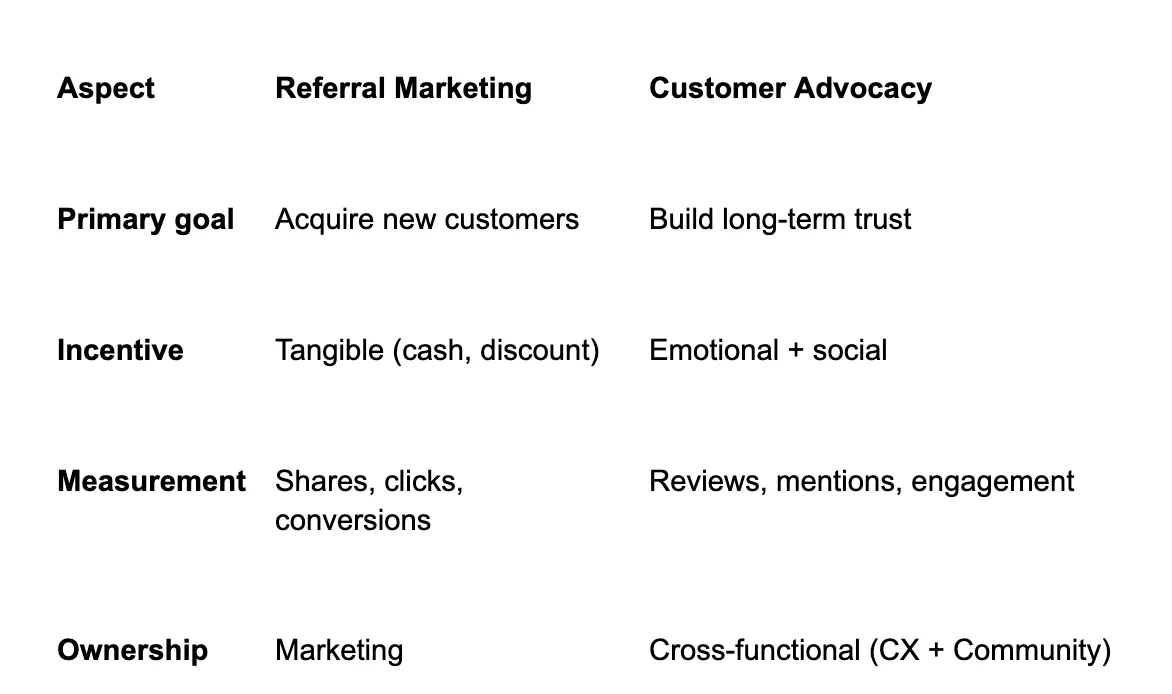
That’s why many high-growth DTC brands combine both. They use referral tools to track conversions while investing in brand communities to deepen advocacy.
For example, creating a post-purchase referral popup encourages happy customers to share right after buying—a simple trigger that fuels advocacy loops.
Building Advocacy: From First Purchase to True Believer
1. Deliver a great first experience
Customer advocacy starts with satisfaction. Fast shipping, quality packaging, and strong post-purchase communication are the foundation.
2. Identify your most vocal customers
Use NPS surveys or social listening to spot those already talking about your brand. Invite them to join your advocacy or referral program.
3. Reward and recognize advocates
Recognition matters as much as rewards. Highlight advocates in social posts, send early product access, or create tiered milestones (e.g., Bronze, Silver, Gold Advocates).
4. Integrate advocacy across channels
Embed referral CTAs on your order confirmation page and customer portal. Promote advocacy in email and SMS touchpoints to keep it visible across the customer journey. Automation tools like GetResponse can help personalize advocacy across specific scenarios.
ReferralCandy’s research found that brands adding two or more advocacy touchpoints see share rates triple—from 4% to 12%.
Scaling Advocacy With Technology
At scale, manual tracking breaks down. Automation keeps advocacy sustainable.
Recommended Features
- Automatic activation: Convert buyers into advocates immediately post-checkout.
- Fraud prevention: Block self-referrals and coupon abuse.
Custom dashboards: Let advocates view their performance in real time. - Integrations: Sync data with Shopify, Klaviyo, and Recharge.
- Scalability with personalization: Use a TTS tool that enables personalized and authentic voices during the demo at the onboarding procedure.
ReferralCandy provides these features under one platform—ideal for stores running both referral and affiliate campaigns without developer support.
Example: Turning Users Into Sales Reps
- A customer buys your product.
- They receive a “Share & Earn” popup with a unique referral link.
- Their friends buy, generating tracked revenue.
- You reward the advocate automatically—cash, store credit, or discounts.
This closed loop turns everyday customers into an extension of your sales team.
Launch / Optimise Checklist
- Add a referral or advocacy widget to your post-purchase page.
- Create personalized referral links or codes for every customer.
- Automate reward fulfillment and notifications.
- Recognize top advocates publicly every month.
- Review share, click, and conversion data weekly.
- If using Shopify, install ReferralCandy to manage advocacy and affiliate tracking from one dashboard.
FAQ
What’s the difference between advocacy and influencer marketing?
Advocacy grows from genuine product satisfaction, not paid sponsorships. Influencer marketing is transactional—paying creators for reach. Advocacy leverages real customers who share authentically and often outperform influencers in conversion rates.
How do I measure advocacy success?
Track advocacy health using referral share rate (5–15%), click-through rate (10–25%), and conversion rate (3–8%) benchmarks. Add qualitative metrics too—reviews, UGC mentions, and repeat referral frequency.
Should every customer become an advocate?
No. Focus on the top 10–20% most engaged customers. They generate most advocacy-driven sales while keeping your reward costs efficient.
What’s the best way to reward advocates?
Cash or cash-equivalent rewards outperform points by about 40% in conversion rates. Still, recognition—like exclusive access or social shoutouts—can deepen long-term loyalty.
Takeaways
- Customer advocacy compounds over time—it’s the most authentic form of marketing.
- Referrals are the foundation, but emotional recognition builds real advocacy.
- Use automation tools like ReferralCandy to scale advocacy without losing the personal touch.
- The result: lower CAC, higher trust, and a community that sells for you.
Need more? Read our guide on the best Shopify referral apps.